
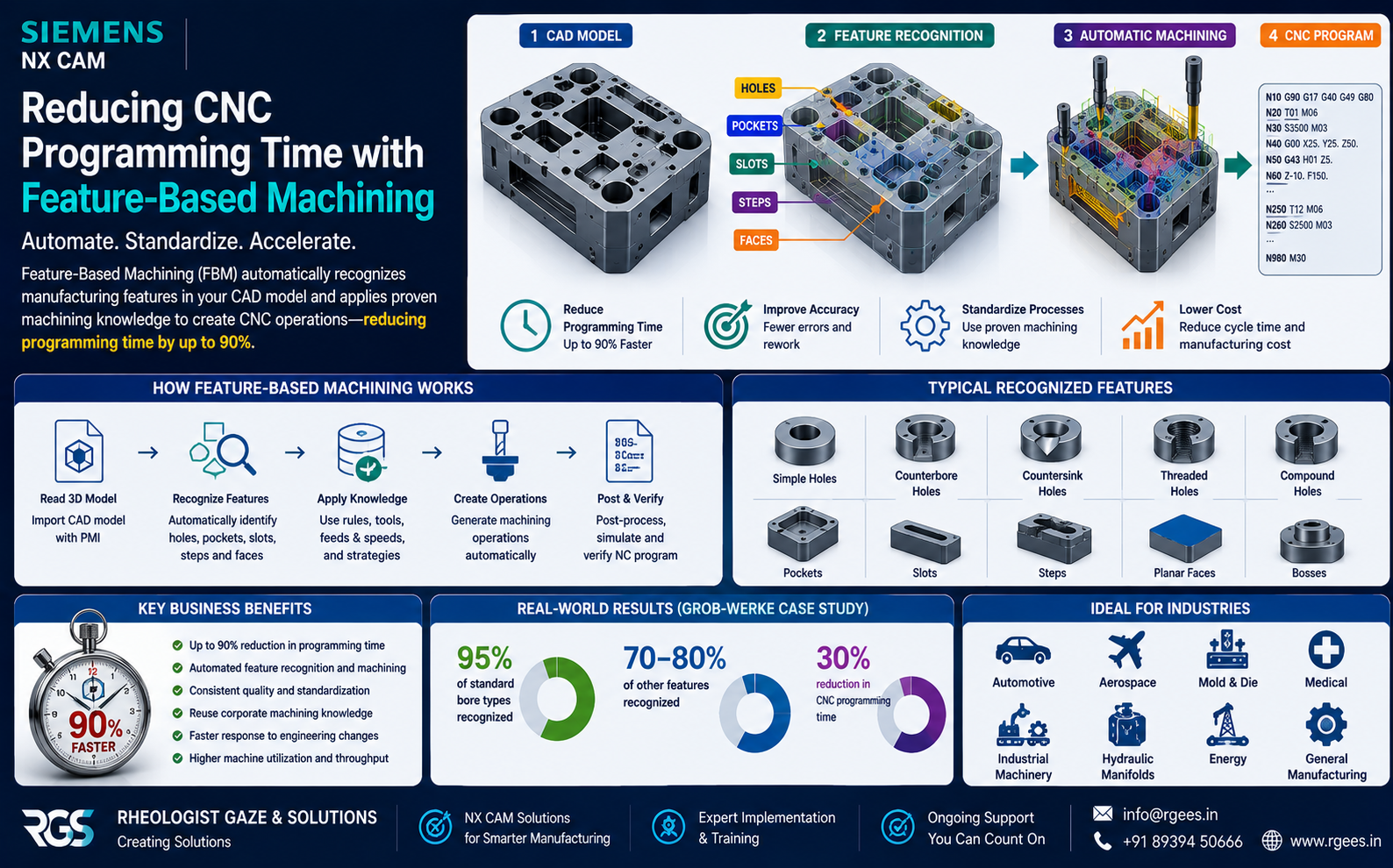
Reducing CNC Programming Time with Feature-Based Machining
Automatically recognize manufacturing features, apply proven machining knowledge and generate CNC operations faster with Feature-Based Machining.
Instead of programming every manufacturing feature manually, modern CAM systems can recognize machining features directly from the 3D product model and apply standardized machining knowledge.
What Is Feature-Based Machining?
Feature-Based Machining (FBM) is a CAM automation technology that identifies manufacturing features in a CAD model and uses those features to help generate appropriate CNC machining operations.
Typical recognizable features can include:
- Simple holes
- Counterbored holes
- Countersunk holes
- Threaded holes
- Compound holes
- Pockets
- Slots
- Steps
- Planar faces
- Prismatic machining regions
Feature-Based Machining: Recognize the feature → determine how it should be machined → create the required operations.
Why Traditional CNC Programming Can Be Time-Consuming
Consider a component containing:
- 40 drilled holes
- 12 counterbores
- 8 threaded holes
- 6 pockets
- 4 slots
A programmer may traditionally need to select geometry and create individual or grouped machining operations for each feature type.
The programmer also has to decide:
- Which tool should be used?
- Should the operation be drilled, milled or bored?
- What machining sequence should be used?
- Should the feature be rough machined first?
- What tolerance must be achieved?
- What surface finish is required?
- Which feeds and speeds should be applied?
For repetitive prismatic components, a large portion of programming time can therefore be spent repeating decisions the company has already made many times before.
How Feature-Based CNC Programming Works
Read CAD Model
The CAM system analyses the 3D product geometry.
Recognize Features
Holes, pockets, slots and other supported manufacturing features are identified.
Apply Knowledge
Machining rules determine suitable tools, processes and operation sequences.
Create Toolpaths
The required CNC machining operations are generated.
Verify
The programmer reviews and validates the resulting machining process.
From CAD Model to Automated CNC Program
Feature-Based Machining in Siemens NX CAM
Siemens NX CAM provides Feature-Based Machining capabilities designed to automate NC programming for prismatic manufacturing.
The technology can recognize manufacturing features and use established machining knowledge to determine how those features should be produced.
Siemens reports that Feature-Based Machining can reduce programming time by up to 90% in applicable workflows.
Automatic CNC Feature Recognition
Feature recognition is one of the foundations of CAM automation.
Instead of requiring the programmer to manually select every individual surface associated with a machining feature, the software analyses the part geometry and identifies manufacturing features.
Examples of Features Suitable for Automated Programming
Automatic Hole Machining
Hole programming is one of the best applications for Feature-Based Machining.
A production component can contain dozens or even hundreds of holes with different:
- Diameters
- Depths
- Tolerances
- Threads
- Counterbores
- Countersinks
- Orientations
NX CAM's automated holemaking capabilities can identify multiple holes, group relevant features and create machining operations efficiently.
This can significantly reduce repetitive hole-selection and operation creation.
Using PMI to Drive CNC Programming
Geometry alone does not always tell the manufacturing engineer how a feature must be machined.
Consider two geometrically identical holes.
One might require a normal drilled finish while another requires a tighter tolerance and smoother surface.
This is where Product and Manufacturing Information (PMI) becomes important.
Dimensions → Tolerances → Surface Finish → Manufacturing Requirements
to help determine appropriate machining methods.
Capture Your Best CNC Programming Knowledge
One of the most valuable aspects of Feature-Based Machining is not simply automatic geometry recognition.
It is the ability to capture manufacturing knowledge.
Experienced CNC programmers make decisions based on years of shop-floor experience.
For example:
- Which drill should be used for a particular diameter?
- When should a hole be reamed?
- Which end mill should machine a particular pocket?
- What operation sequence produces the best result?
- What cutting parameters work best for a given material?
These decisions can be captured as standardized machining practices and reused in subsequent programs.
Feature-Based Machining Helps Standardize CNC Programming
Standard Tools
Apply preferred cutting tools for recognized manufacturing features.
Standard Operations
Reuse approved machining sequences for similar features.
Standard Parameters
Apply company-approved cutting conditions based on manufacturing requirements.
Repeatable Processes
Program similar components using more consistent machining methods.
Quality Consistency
Reduce unnecessary variation between programmers and jobs.
Knowledge Reuse
Reuse machining expertise across different programmers and future projects.
Example: Programming a Prismatic Machined Component
| Programming Activity | Traditional Approach | Feature-Based Approach |
|---|---|---|
| Identify holes | Manual selection | Automatic recognition |
| Classify hole type | Programmer interpretation | Recognized from geometry / manufacturing data |
| Select tools | Manual tool selection | Rules can recommend or apply preferred tools |
| Create operations | Manual | Automated where supported |
| Operation sequence | Programmer decides repeatedly | Standard process knowledge can be reused |
| Cutting parameters | Selected manually | Can be driven by manufacturing knowledge |
| Verification | Required | Still required |
Benefits of Feature-Based Machining
Reduce Programming Time
Automate repetitive feature recognition and operation creation.
Program Parts Faster
Move from the product model to machining operations with fewer manual steps.
Reduce Programming Errors
Standardized methods can reduce mistakes caused by repetitive manual programming.
Improve Consistency
Different programmers can apply common manufacturing best practices.
Capture Manufacturing Knowledge
Convert expert machining practices into reusable automation rules.
Reduce Engineering Cost
Spend less programming time on repetitive tasks and more time optimizing complex manufacturing requirements.
Real-World Example: CNC Programming Automation at GROB
Siemens documents a manufacturing case study involving GROB-WERKE using NX CAM Feature-Based Machining.
According to the case study, automated feature recognition covered approximately:
- 95% of standard bore types
- 70–80% of other relevant features
GROB reported that the implementation reduced CNC programming time by 30% and also reduced the number of different tools used.
Where Feature-Based Machining Provides the Greatest Value
Feature-Based Machining for Hydraulic Manifolds
Hydraulic manifolds are excellent candidates for machining automation because they may contain large numbers of:
- Drilled passages
- Threaded holes
- Counterbores
- Cross holes
- Precision bores
- Port features
Programming each of these manually can consume significant engineering time.
Feature recognition and standardized holemaking processes can substantially reduce repetitive programming effort.
Feature-Based Machining for Mould and Die Components
Although complex mould cores and cavities often require specialized 3-axis and 5-axis surface machining, many tooling components also contain repetitive prismatic features.
Examples include:
- Mould-base holes
- Ejector holes
- Cooling connections
- Screw holes
- Pockets
- Slots
- Plate machining
Feature-Based Machining can help automate these routine operations while CAM programmers focus on complex core, cavity and electrode machining.
Turn CNC Programming Experience into Reusable Company Knowledge
A manufacturing company may have several senior CNC programmers who understand its machines, cutting tools and machining strategies extremely well.
The challenge is:
Feature-Based Machining provides a path toward capturing repeatable manufacturing methods digitally.
This can help:
- Train new programmers faster
- Reduce dependency on individual experience
- Standardize manufacturing across departments
- Reuse proven machining methods
- Improve process consistency
Does Feature-Based Machining Replace the CNC Programmer?
No.
Feature-Based Machining is most effective when it automates repetitive and predictable programming tasks.
Experienced manufacturing engineers are still required to:
- Define machining strategy
- Establish automation rules
- Select the best process when multiple options exist
- Program complex geometry
- Review cutting conditions
- Verify toolpaths
- Validate fixtures and setups
- Approve NC output
Feature-Based Machining and the Future of AI-Assisted CAM
CAM automation continues to evolve beyond conventional rule-based feature recognition.
In NX X Manufacturing 2512, Siemens introduced AI Make Machining Suggestion.
The AI-assisted capability can evaluate selected geometry and propose multiple machining solutions containing operations, tools and cutting parameters.
The programmer remains responsible for evaluating the proposed solutions and choosing the approach that best fits the manufacturing requirement.
This represents a broader direction for CNC programming:
How to Implement Feature-Based Machining in Your Tool Room
Study Existing Parts
Identify frequently repeated manufacturing features.
Standardize Tools
Define preferred cutters, drills and machining resources.
Capture Processes
Document proven machining methods for recurring features.
Configure Automation
Build feature-based machining rules around company standards.
Measure Results
Compare programming time, consistency and CNC productivity.
Where Does the ROI Come From?
| Current Challenge | Feature-Based Machining Opportunity |
|---|---|
| Long programming time | Automate repetitive operation creation |
| Repeated hole programming | Automatic recognition and holemaking |
| Different methods between programmers | Reuse standardized machining knowledge |
| Experienced programmers overloaded | Automate predictable work |
| New programmer training | Embed company best practices into CAM |
| High-mix manufacturing | Reuse processes across similar features |
| Programming errors | Apply repeatable automated processes |
| Slow response to new jobs | Accelerate CAD-to-NC workflow |
NX CAM Automation Support from Rheologist Gaze & Solutions
Rheologist Gaze & Solutions can support manufacturing companies evaluating Siemens NX CAM for automated CNC programming.
Our discussions can cover:
- Existing CNC programming workflow
- Feature-Based Machining
- Automatic feature recognition
- Automated holemaking
- Prismatic part programming
- 2.5-axis machining
- 3-axis machining
- 5-axis machining
- PMI-driven manufacturing
- Machining knowledge standardization
- CAD/CAM integration
- CAM automation opportunities
- Implementation
- Training
- Technical support
Frequently Asked Questions About Feature-Based Machining
What is Feature-Based Machining?
Feature-Based Machining is a CAM automation approach that recognizes manufacturing features in a CAD model and applies predefined machining knowledge to create relevant CNC operations.
How much can Feature-Based Machining reduce CNC programming time?
Siemens reports programming-time reductions of up to 90 percent for applicable NX CAM feature-based machining workflows. Actual results depend on component geometry, feature types and the level of automation implemented.
Can Feature-Based Machining recognize holes automatically?
Yes. Automated holemaking can identify multiple hole types and create appropriate machining operations based on the configured process.
Can NX CAM use tolerances and surface finish information?
Yes. Feature-Based Machining can use PMI associated with the 3D model, including tolerance and surface-finish information, to support machining-process selection.
Is Feature-Based Machining useful for mould manufacturing?
Yes. It is particularly useful for automating repetitive prismatic operations on mould bases, plates, inserts and other tooling components.
Does Feature-Based Machining replace CAM programmers?
No. It automates repetitive tasks while experienced programmers remain responsible for machining strategy, complex geometry, optimization, verification and final NC-program approval.
Conclusion: Stop Programming the Same Feature Again and Again
Many CNC programming tasks are repetitive.
The same hole types, pockets, slots and machining processes appear across different components every day.
Instead of asking experienced programmers to recreate these operations manually for every job, Feature-Based Machining allows manufacturers to capture successful machining knowledge and reuse it automatically.
That is the foundation of Feature-Based Machining.
For manufacturers handling large numbers of prismatic components or repetitive machining features, the technology can provide an important path toward shorter CNC programming time, standardized manufacturing processes and improved engineering productivity.
Want to Reduce Your CNC Programming Time?
Talk to Rheologist Gaze & Solutions about Siemens NX CAM, Feature-Based Machining and CNC programming automation for your manufacturing operations.
Request an NX CAM Demonstration info@rgees.in +91 89394 50666Technical reference: Siemens NX CAM – Feature-Based Machining and CNC programming automation.
SEO Focus Keywords: Feature Based Machining, Feature-Based Machining, NX CAM Feature Based Machining, CNC programming automation, automated CNC programming, automatic feature recognition, CNC feature recognition, NX CAM automation, reduce CNC programming time, automated hole machining, PMI driven machining, prismatic machining, automated toolpath generation, CAM automation, Siemens NX CAM.