
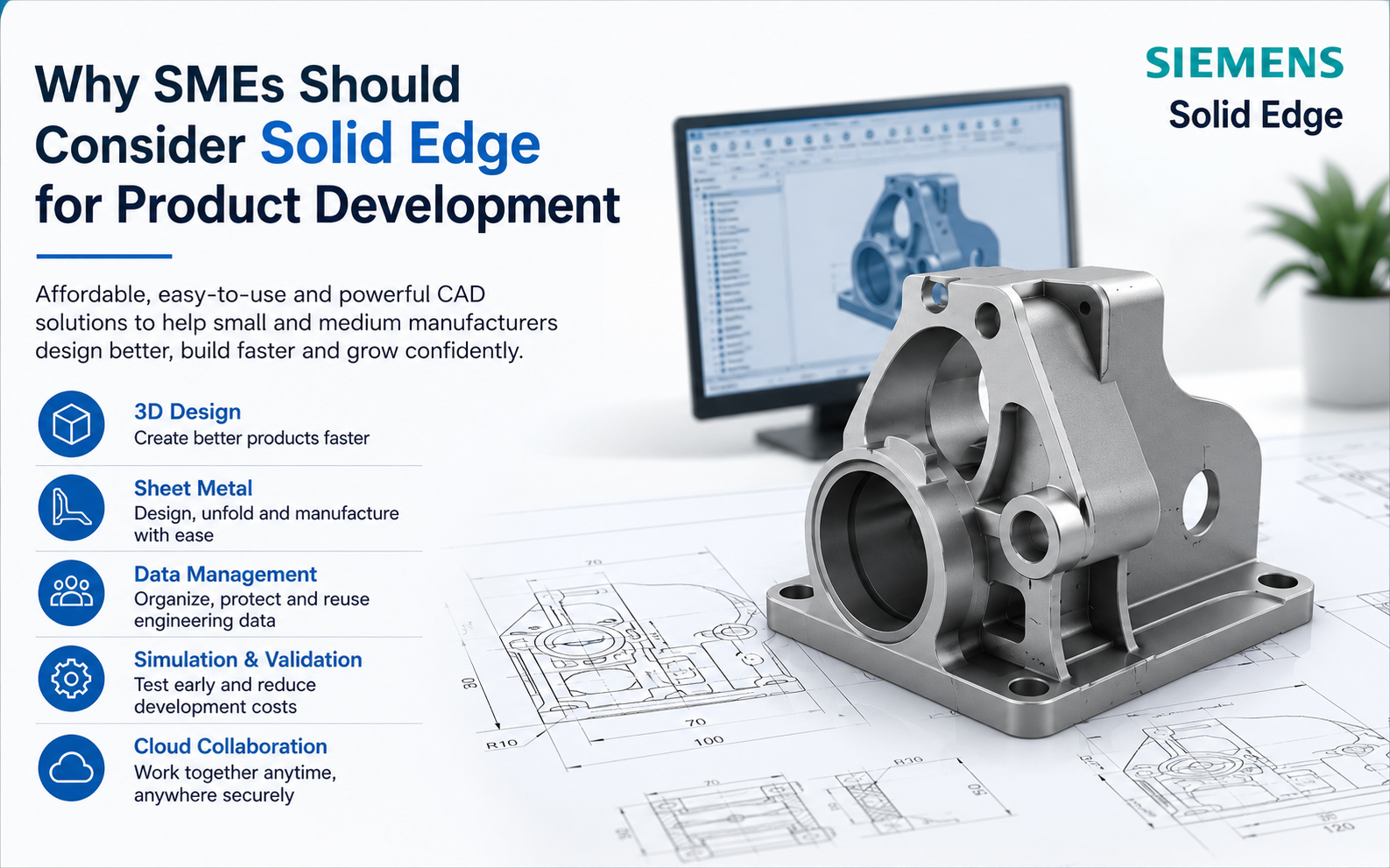
Why SMEs Should Consider Solid Edge for Product Development
Professional 3D CAD does not need to be limited to large enterprises. Solid Edge gives growing manufacturers a scalable environment for design, engineering changes, sheet metal, assemblies, simulation, documentation and product-data management.
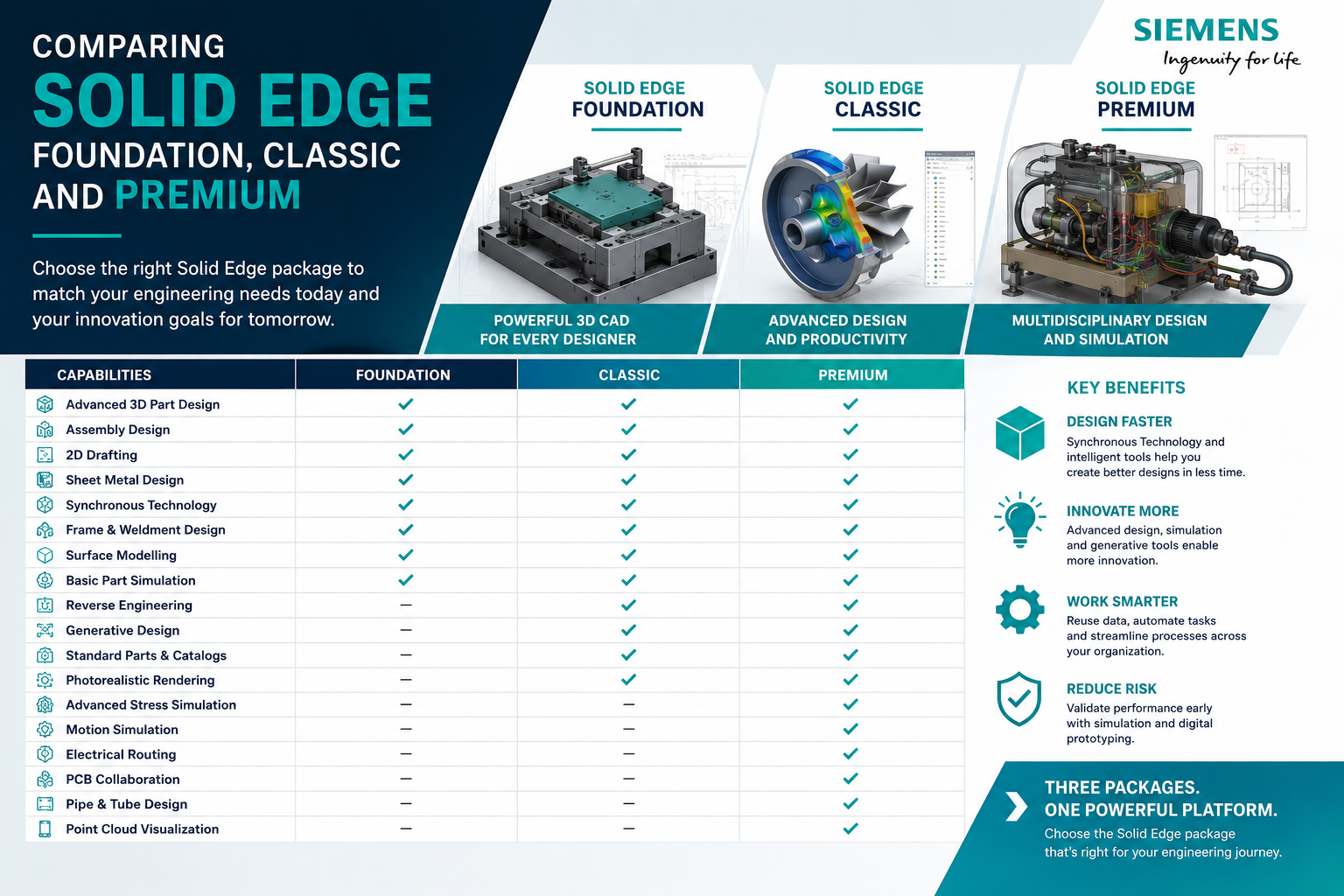
Siemens positions Designcenter Solid Edge as an affordable and easy-to-use product-development portfolio covering multiple stages of the engineering process.
Common Product Development Challenges for SMEs
Short Delivery Schedules
Customers expect faster design changes, quotations, prototypes and production releases.
Limited Engineering Budget
Software investment must deliver clear value without creating unnecessary cost or IT overhead.
Frequent Customer Changes
Engineering teams need to modify product geometry quickly without rebuilding entire models.
Small Engineering Teams
A few engineers may need to handle CAD, drawings, customer revisions, production support and documentation.
CAD File Management
As projects increase, uncontrolled folders and file copies can create revision and release problems.
Design-to-Manufacturing Gap
Design information must move efficiently toward fabrication, machining, assembly and production.
Why Solid Edge Can Be a Strong Fit for SMEs
Solid Edge provides more than conventional 3D modelling.
It forms part of a broader product-development environment that can grow with the engineering needs of a manufacturing company.
Product Development Capabilities for Growing Manufacturers
1. Move from 2D CAD to Professional 3D Product Development
Many SMEs begin engineering with 2D CAD because it is familiar and simple.
As product complexity increases, relying entirely on 2D drawings can create challenges in:
- Assembly visualization
- Interference checking
- Customer communication
- Engineering changes
- Reuse of existing designs
- Manufacturing documentation
Solid Edge allows companies to introduce professional 3D mechanical design while continuing to support 2D drafting.
2. Make Engineering Changes Faster with Synchronous Technology
Small manufacturers frequently work with:
- Customer-supplied CAD files
- Legacy designs
- Imported STEP models
- Supplier geometry
- Existing products requiring modification
Solid Edge combines direct modelling with parametric design through Synchronous Technology.
This provides engineers with flexible tools for changing geometry, including imported models, without always being dependent on the original feature history.
For SMEs that frequently customize products for individual customers, this can be particularly useful.
3. Reuse Existing Designs Instead of Starting Every Project Again
One of the greatest productivity opportunities for an SME is effective design reuse.
Many new customer projects are not completely new products.
They are variations of something the company has already engineered.
A structured CAD environment helps companies turn previous engineering work into reusable intellectual property.
4. Design Complete Machines and Assemblies
SMEs producing machinery, automation systems, industrial equipment or special-purpose machines frequently need to manage complex assemblies.
Typical assemblies may combine:
- Machined parts
- Sheet metal components
- Purchased components
- Fasteners
- Motors
- Gearboxes
- Frames
- Brackets
Solid Edge provides part and assembly modelling capabilities within the same engineering environment.
5. Dedicated Sheet Metal Design for Fabrication SMEs
Sheet metal is important for many small and medium manufacturers.
Applications include:
- Electrical enclosures
- Control panels
- Machine guards
- Industrial cabinets
- Equipment covers
- Brackets
- HVAC products
Solid Edge provides dedicated sheet-metal features rather than requiring engineers to model fabricated components only as generic solids.
Engineers can develop:
- Bends
- Flanges
- Formed features
- Cutouts
- Flat patterns
- Fabrication drawings
6. Start Managing CAD Data Before File Chaos Begins
An SME may initially manage CAD data using Windows folders.
This can work with a small number of projects.
But as the business grows, questions begin to appear:
- Which file is the latest revision?
- Who changed this drawing?
- Has this part been released?
- Which assembly uses this component?
- Can we safely copy this design for a new project?
Solid Edge provides scalable CAD data-management capabilities designed for organizations ranging from individual users to larger manufacturers.
Data-management capabilities can support:
- Revision management
- Release management
- CAD file organization
- Search and reuse
- Controlled engineering changes
- File sharing
7. Designcenter X Solid Edge Can Reduce IT Complexity
Not every SME wants to manage extensive CAD infrastructure internally.
For organizations that prefer a SaaS approach, Designcenter X Solid Edge provides Solid Edge product-development capabilities in a secure cloud-connected environment.
This approach can provide benefits including:
Cloud-Connected CAD
Access professional product-development capabilities within a modern SaaS environment.
Automatic Updates
Reduce the effort involved in distributing and maintaining software updates.
Built-In Data Management
Manage engineering information using cloud-connected data-management capabilities.
Collaboration
Share and collaborate more effectively with engineering colleagues and other project stakeholders.
Reduced IT Overhead
Allow smaller IT teams to spend less time maintaining CAD infrastructure.
Scalable Growth
Expand the engineering environment as your design organization grows.
8. Introduce Simulation Earlier in Product Development
Physical prototypes are valuable, but multiple prototype cycles can be expensive for smaller companies.
Digital simulation provides an opportunity to evaluate certain design problems earlier.
Depending on the required configuration and engineering workflow, simulation can help teams investigate areas such as:
- Structural behaviour
- Load conditions
- Design validation
- Fluid and thermal performance
- Product optimization
is often more efficient than:
CAD → Prototype → Failure → Redesign → New Prototype
9. Generate Manufacturing Drawings from the 3D Model
For most SMEs, engineering drawings remain essential for manufacturing.
A connected 3D CAD environment enables drawings to be generated from the product model rather than being developed as completely independent documents.
This improves continuity between:
- 3D design
- Dimensions
- Bill of materials
- Part drawings
- Assembly drawings
- Manufacturing information
10. Improve Communication with Customers and Suppliers
A 3D product model can significantly improve technical communication.
Instead of asking customers to interpret complex 2D drawings, design teams can use:
- 3D models
- Rendered images
- Exploded views
- Technical illustrations
- Product animations
This can help reduce misunderstanding before manufacturing begins.
Solid Edge Can Grow Beyond Basic CAD
A common concern for SMEs is whether an affordable CAD platform will still be sufficient as the company grows.
Solid Edge is designed as a broader product-development portfolio.
| Business Stage | Typical Requirement | Solid Edge Opportunity |
|---|---|---|
| Starting 3D CAD | Part and assembly design | Professional 3D CAD |
| Growing Fabrication | Sheet metal and drawings | Dedicated sheet metal workflow |
| Increasing Projects | File and revision management | Scalable data management |
| Higher Product Complexity | Design validation | Simulation capabilities |
| Distributed Team | Remote collaboration | Cloud-connected workflow |
| Digital Manufacturing | Closer connection to production | Broader Siemens manufacturing ecosystem |
Basic CAD vs Integrated Product Development
| Requirement | Basic CAD Approach | Solid Edge Product Development |
|---|---|---|
| 2D Drafting | Yes | Yes |
| 3D Part Design | Varies | Professional |
| Assembly Design | May be limited | Integrated |
| Sheet Metal | May require manual modelling | Dedicated |
| Engineering Changes | Can require more manual work | Synchronous editing available |
| Data Management | Folder-based | Scalable CAD data management |
| Simulation | Usually separate | Available within broader portfolio |
| Cloud Collaboration | Depends on system | Designcenter X Solid Edge available |
| Future Expansion | May require replacing platform | Scalable product-development ecosystem |
Business Benefits for SMEs
Shorter Design Lead Time
Use 3D design, reuse and flexible editing to complete projects faster.
Reduce Engineering Errors
Improve design understanding and maintain stronger continuity between models and drawings.
Control Product Development Cost
Reduce repetitive engineering and avoid unnecessary prototype and rework cycles.
Respond Faster to Customers
Modify existing product designs and produce customer-specific variants more efficiently.
Protect Engineering Knowledge
Organize product data so previous engineering work can be found and reused.
Scale with Business Growth
Expand design, data-management and engineering capabilities as product complexity increases.
Which SMEs Can Benefit from Solid Edge?
How an SME Can Start with Solid Edge
Study Current Workflow
Identify problems with 2D CAD, engineering changes and file management.
Select User Roles
Identify designers, drafting users and specialist engineering users.
Choose CAD Package
Select capabilities based on actual engineering requirements.
Train the Team
Build practical skills around live company products rather than only generic exercises.
Expand Gradually
Introduce data management, simulation and additional workflows as the business grows.
How Should an SME Evaluate CAD ROI?
CAD investment should not be evaluated only based on the licence price.
A more useful calculation considers:
- Engineering hours saved
- Reduction in drawing errors
- Number of reusable product designs
- Faster response to customer changes
- Reduced prototype iterations
- Reduced manufacturing rework
- Improved engineering-data control
- Number of additional projects the team can complete
The better question is: “Which CAD system helps our small engineering team deliver more projects with fewer errors and less rework?”
Solid Edge Can Also Support Early-Stage Product Companies
Siemens currently provides a Solid Edge startup program for qualifying early-stage businesses.
This can be particularly relevant for companies developing:
- New industrial products
- Medical equipment
- Consumer products
- Automation products
- Mechanical devices
- Hardware startups
For growing product companies, beginning with a professional engineering platform can reduce the need for disruptive CAD migration later.
Solid Edge Implementation Support from Rheologist Gaze & Solutions
Rheologist Gaze & Solutions can support small and medium manufacturers evaluating Siemens Solid Edge for product development.
Our discussions can include:
- Current CAD workflow assessment
- 2D-to-3D CAD migration
- Product and assembly design
- Sheet metal design
- Engineering-change workflow
- CAD data management
- Solid Edge X / cloud deployment
- Simulation requirements
- Manufacturing workflow
- CAD package selection
- Software implementation
- User training
- Technical support
Frequently Asked Questions About Solid Edge for SMEs
Is Solid Edge suitable for small manufacturing companies?
Yes. Solid Edge provides scalable professional product-development capabilities that can support small design teams as well as larger manufacturing organizations.
Can an SME move from 2D CAD to Solid Edge?
Yes. Solid Edge supports both 2D drafting and professional 3D design, allowing companies to gradually transition engineering processes toward model-based product development.
Does Solid Edge support sheet metal fabrication?
Yes. Solid Edge provides dedicated sheet-metal design capabilities, including bends, flanges, formed features and manufacturing flat patterns.
Can Solid Edge manage CAD revisions?
Yes. Solid Edge data-management solutions provide capabilities for revision, release and engineering file management.
Is there a cloud version of Solid Edge?
Yes. Designcenter X Solid Edge delivers product-development capabilities in a SaaS environment with cloud-connected deployment, collaboration and data-management functionality.
Can Solid Edge be used for machine design?
Yes. Solid Edge can be used to design mechanical parts, assemblies, sheet metal components, fabricated equipment and complete machinery.
Can Solid Edge scale as our company grows?
Yes. Solid Edge forms part of a broader Siemens product-development portfolio, allowing companies to introduce additional data management, simulation and manufacturing capabilities as requirements increase.
Conclusion: SMEs Need Professional Product Development Too
Digital product-development tools are no longer relevant only to large enterprises.
Small and medium manufacturers compete for many of the same customers and face the same pressure for quality, shorter lead times and rapid engineering changes.
What SMEs need is an engineering environment that can provide professional capabilities without creating unnecessary complexity.
Solid Edge provides SMEs with a path toward a more connected product development process while allowing the engineering environment to expand as the business grows.
Is Your SME Ready to Move to Professional 3D Product Development?
Talk to Rheologist Gaze & Solutions about Siemens Solid Edge for mechanical design, sheet metal, machine design, data management and digital product development.
Request a Solid Edge Demonstration info@rgees.in +91 89394 50666SEO Focus Keywords: Solid Edge for SMEs, CAD software for SMEs, CAD for small manufacturers, Solid Edge product development, Siemens Solid Edge India, affordable 3D CAD, mechanical design software for SMEs, sheet metal CAD software, Solid Edge X, CAD data management, product design software for small business, CAD software for manufacturing SMEs.